

Now dish, what is sheet metal bending? It is actually a technique for forming flat metal plates into different shapes. Force is applied on the plane sheet, where it gets bent into a straight line. The process creates a new shape without cutting off any material. These form parts through a series of operations in a variety of industries. The various examples for this include automobiles, aircraft, and electronic cabinets. You can learn from this guide that nothing is too complicated. The essential aspects are the common methods, design suggestions, and ways to troubleshoot.

Principaux enseignements
- Sheet metal bending morphs flat metal into V, U shapes or channels through the application of force.
- The force should be sufficiently large to make a permanent change. This is called plastic deformation.
- Essential aspects to manage are springback, bend radius, and material type.
- A press brake is the most popular machine. It applies a punch and die responsible for the bending operation.
- CNC technology has advanced bending towards a new level of precision and repeatability.
The Elementary Physics: Understanding Bending Mechanism
Firstly, we have to address the bending physics of the sheet metal which is essential to comprehend it. Bending is more than just the application of force. It is a useful method to rearrange the metal atom layers in a controlled manner. These fundamental principles are necessary to learn for designing good parts and for avoiding errors.
Plastic vs. Elastic Deformation
Applying minor stress to the metal will create a bend; however, upon removing the stress, it will return to its flat shape. This tendency is referred to as elastic deformation. To create a bend instead of elastic deformation, we have to provide enough force to go past the material’s yield strength. A permanent change is initiated by the achieved plastic deformation. The principal aim of sheet metal bending is therefore to get just the right amount of plastic deformation.
The Neutral Axis, Stretching, and Compression
Imagine a line that runs through the exact center of the sheet’s thickness. This line is called the neutral axis. In a bending scenario where the neutral axis does not change in length, the material on the curve’s outside has to stretch. That is it is under tension. The material on the inside of the bend gets squeezed together. It is under compression. This knowledge is useful for designers since they can now understand what happens to a flat part when it is bent.
Awareness of Springback
Once the part has been bent, the metal will get back some of its original shape after the force has been removed which is springback. This movement contains a very small degree of springback. It is produced as a result of the stresses that are left over in the material. To achieve the correct final angle we must “over-bend” the part a little bit to make up for this. Springback is more critical in high-strength steels and titanium than in soft materials such as aluminum. We must always consider it in the planning stage.
Common Sheet Metal Bending Methods: A Comparative Look
When it comes to the ways sheet metal bending is done, there are various techniques that can be used. Different techniques are utilized depending on the specific advantages of each. Acquainting oneself with the essentials of sheet metal bending is also knowing the commonly used methods. In this section, we shall review the most popular techniques.

| Méthode | Processus | Meilleur pour | Limites |
|---|---|---|---|
| V-Bending | A punch presses the sheet into a V-shaped die. | The most common and flexible method for creating V-shapes and angles from acute to obtuse. | The inside radius is set by the punch tip and die opening, not just the tooling. |
| U-Bending | Similar to V-bending, but uses a U-shaped die. | Creating U-channels and deep, parallel bends in one operation. | Limited to creating U-shapes; less flexible than V-bending. |
| Roll Bending | The sheet passes through three or more rollers to form a curve. | Creating large-radius bends, cylinders, cones, and other curved shapes. | Not suitable for sharp, angular bends. Requires more setup time. |
| Rotary Bending | A rotating tool “wipes” the material against a die. | Bending pre-painted or sensitive surfaces without leaving marks. Good for sharp bends. | More complex tooling and generally slower than V-bending. |
V-Bending Sub-Types
V-bending is the most common process and so, in fact, it includes three basic techniques:
* Air Bending: The punch pushes the metal into the V-die. But the metal only touches the top edges of the die and the tip of the punch. This method is flexible and needs less force.
* Bottoming: The punch presses the material so it matches the full shape of the die. This gives more accurate angles than air bending but needs more force.
* Coining: A very high-force method where the punch tip presses into the metal. This makes it thinner and creates a very sharp, lasting bend with almost no springback.
The Instrumentation of the Craft: Bending Machines and Tooling
Mechanical tools and machines, more than everything else, play a role in the process of sheet metal bending. These are the machines that apply the high forces necessary to conform to a given shape. With the right equipment, the designer really gets to be creative and, in the end, a flat sheet will look like a finished part.
The Press Brake: The Main Equipment for Bending
The press brake denotes the central machine used in bending operations. It has a stationary bed on the bottom and a moving ram on top. The punch is attached to the ram. The die is set on the bed. Hydraulic press brakes utilize fluid pressure to displace the ram. As a result, they deliver a lot of power. Electric press brakes use servo motors. This ensures a high speed together with power efficiency.
Punch and Die: The Shaping Tools
The punch (the upper tool) and the die (the lower tool) actually shape the metal. They come in hundreds of shapes and sizes. The combination of a specific punch and die determines the final angle and inside radius of the bend. Tool selection is a critical skill for a press brake operator.
The Role of CNC in Modern Bending
The new generation press brakes commonly feature Computer Numerical Control or CNC. This is a device that automates the operation of the bending machine. The operator supplies the machine with the specifications for the parts. The machine works out the required forces and the distances setting for each bend. CNC bending is thus a significant aspect in the field of fabrication de tôles. With CNC, the products are continually produced in high precision and repeatability. This process of forming is entirely different than subtractive manufacturing. For turning parts that are round or complex, a mechanism like Services de tournage CNC is used. This one cuts material away from the final part rather than forming it.
From Design to Bent Part: A Practical Walkthrough

Turning a technical drawing into a real, physical object is a multi-stage operation that involves different sequences. This is the practical application of how a plain sheet of metal changes into a finished part. We will take a tour through the entire process that goes from detailed drawing to the end inspection.
Step 1: Design & Calculation (The Blueprint)
The very first step is that 2D or 3D CAD file which has to be there. This file sets the shape of the workpiece at the end of the task. Engineers have to make calculations in order to create an exact flat pattern for bending. The ones they need to determine are the Bend Allowance ou Bend Deduction which are dependent on a number called the K-Factor. This communicates the position of the neutral axis. These figures must be correct for the part to be accurate.
Step 2: Material Selection
The type of material selected greatly influences the bending process. Soft aluminum like 5052-H32 has a good ductility and can bend very easily with a small radius. A high-strength material like A36 steel usually requires us to apply more force and to use a larger bend radius to avoid the cracking. Angles and thickness of the materials will be the main considerations for the assisting inputs in the next step.
Step 3: Programming the Press Brake
Programming the machine as per the design information is the next step after acquiring the final drawing. The material type, thickness and the desired bend angles are entered into the CNC controller. The controller then calculates the required force and the exact position for the back-gauges. The back-gauges are used to position the part each time the lay is bent.
Step 4: The Bending Operation
The operator takes a flat part which can either be laser cut or punched and sets it into the press brake. The part is aligned against the back gauges. This measure ensures that the part is bent at the right position. Thereupon, it finishes the bending cycle by activating the ram. The punch presses into the material and makes the bend. For multi-bend parts, the operator must carry out the sequence in the proper order.
Step 5: Quality Control & Inspection
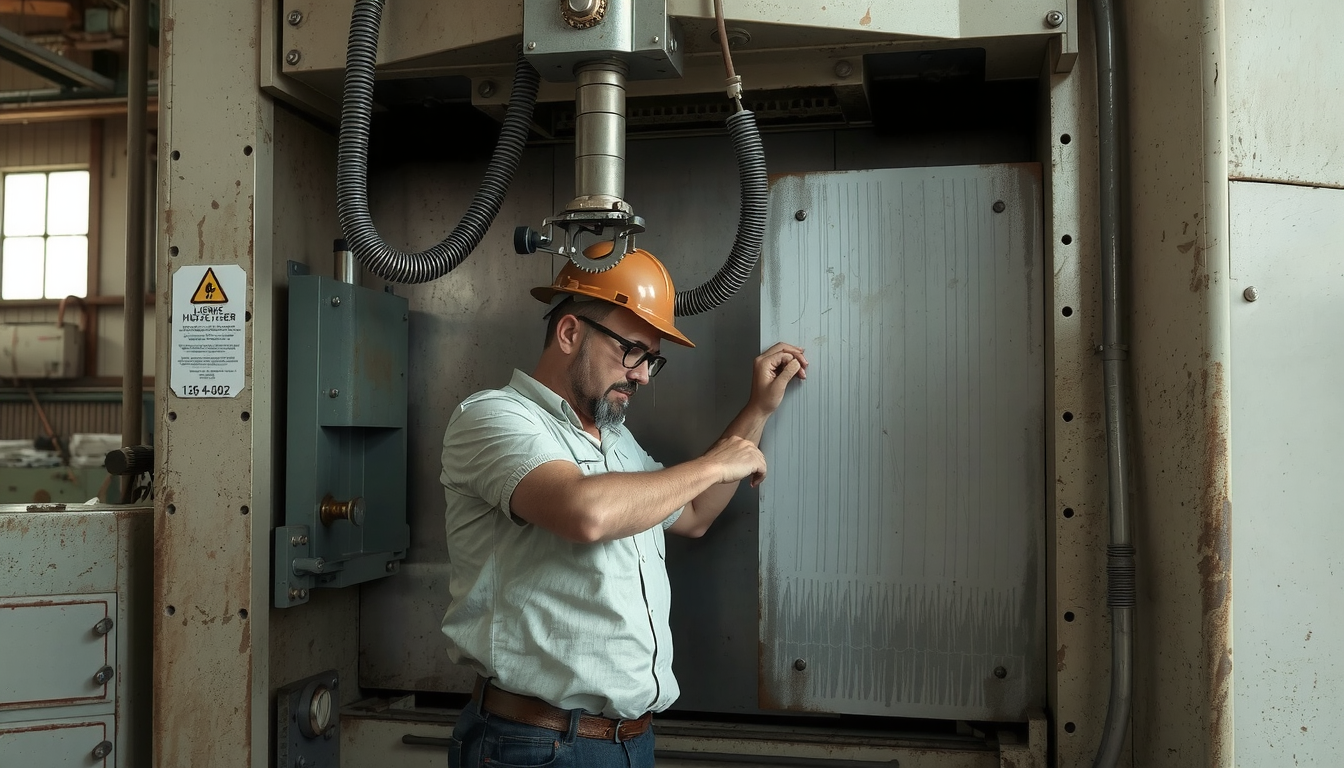
The bent first part will go through careful inspection afterward. Protractors and calipers are used to check whether the bend angles and the dimensions are correct. If the angle is off because of springback, the operator will adjust the CNC program. Once the first part is perfect the production of the rest of the batch can begin.
Troubleshooting Common Bending Defects: An Operator’s Guide
Even the most upgraded machine can have setbacks. Our shop experiences have shown that being able to spot and fix common problems is the basis of quality work. Learning what is sheet metal bending involves also being aware of its problems.
Below is a reference to common issues we deal with.
| Défaut | Potential Cause(s) | Solution(s) |
|---|---|---|
| Cracking on the bend exterior | The bend radius is too small for the material’s ability to stretch. The material is not very ductile. | Increase the inside bend radius. Bend perpendicular to the material’s grain direction if possible. Anneal (heat-treat) the material to make it softer. |
| Inaccurate Bend Angle | Incorrect calculation for springback. The punch or die is worn out. | Adjust the over-bend angle in the CNC program. Inspect the tooling for wear and replace it if needed. |
| Die Marks on the Part | The pressure is too high. The die has sharp edges. | Use a die with a larger opening (V-die) or a larger radius. Place a special protective film on the material before bending. Switch to rotary bending if the surface finish is critical. |
Bending vs. Folding: What’s the Real Difference?
“Bending” and “folding” are very often specified interchangingly as if they mean the same thing, however, these two are very close but there is a technical difference. Though both methods produce angles in the sheet metal they have differences in material manipulation.
In a bending operation using the normal side of a press brake the punch comes down and forces the workpiece to form a bend in the die. As this happens, both sides of the workpiece can turn up and down as the bend is forming.
When it comes to folding, most of the sheet is clamped down and held still. A folding beam swings up or down to fold the edge of the material. This keeps the larger part of the workpiece flat and stable. This can be useful for very large or heavy panels.
Conclusion: Bending as a Cornerstone of Fabrication
In short, sheet metal bending is an accurate, adaptable, and crucial manufacturing process in the modern industry. It forms flat sheets into complex, durable parts that are applications in almost every area of life. From basic physics about deformation to high-tech computerized control of CNC machines, a comprehensive knowledge of this process is what makes average designs turn into great manufacturing.
The key to success is to master the principles, methods, and design rules. In order to get a complete range of fabrication solutions that meet your specific needs and have expert guidance on what is sheet metal bending, you can check out the services offered by professionals like Mékalite. You can also Learn From Experts.
Frequently Asked Questions (FAQ)
What is the K-Factor in sheet metal bending?
The K-Factor is a ratio. It represents the location of the neutral axis compared to the material’s thickness. It’s a key value used in CAD software. It helps to accurately calculate the bend allowance and find the correct flat pattern length of a part before it is bent. A typical K-Factor is between 0.33 and 0.50.
What is a minimum bend radius?
The minimum bend radius is the smallest radius you can bend a sheet metal part to. If you bend it smaller than this radius, it might crack or get too thin. This radius depends on the material’s ability to stretch and its thickness. Bending below this radius risks part failure.
How does material thickness affect sheet metal bending?
Thickness is a very important factor. Thicker materials need much more force to bend. They also need a larger inside bend radius to stop cracking. Thicker materials also have more springback than thinner sheets of the same metal.
Can you bend all types of metal?
Most metals that can stretch can be bent. However, their properties are very different. Soft metals like aluminum and low-carbon steel are easy to bend. Harder materials like high-strength steel or titanium are much harder to work with. They need more force and careful planning for springback and bend radii. Brittle materials, such as cast iron, cannot be bent.
What is the difference between sheet metal bending and stamping?
Sheet metal bending is a forming process that creates bends along a straight line, usually with a press brake. Stamping is a wider term. It can include bending, but it also covers other processes like blanking (cutting), punching holes, and coining. Stamping is often done at high speed in a large press with part-specific dies to make huge numbers of identical parts.
