



Are you in the mood to design and also build a custom, sturdy container? Your decision to read this article is indeed a great one. Mastering the art of constructing a box from sheet metal is a very important skill for any DIY enthusiast. It gives you the chance to make strong, precise boxes for storage, electronics, or custom projects.

This guide will furnish you with all the necessary steps to achieve the task. We will take you through every step from getting the required tools and materials to the final assembly. In the end, you will have the ability to design, cut, bend, and finish your own sheet metal box. Let’s jump into it.
Prior to Your Initiation: Tools and Materials You Cannot Do Without
The key to a successful project is good preparation. Before you even make the initial cut, it is necessary first to gather all the required tools and materials. Having all of the tools read and present will make the process of work run smoother and safer. This checklist is your best helper to get organized.
Your Sheet Metal Selection
The metal that you select is what influences how difficult the project will be. It also impacts how long the box would hold up. For people who are new to this, some metals are better than others.
- Aluminio: This is a good suggestion for a first project. It is quite light and resistant to rust. It is less complicated to cut and bend.
- Mild Steel: This material is strong and cheap but is heavier than aluminum. It will rust over time if not painted or coated.
- Galvanized Steel: This is basically steel coated with zinc to prevent rust from forming. It is a good middle option. However, if you decide to weld it, be cautious about the fumes.
The thickness of the metal is called its gauge. A higher gauge number indicates that the metal is thinner. A good initial choice for a small box is a 20 to 24-gauge sheet. It is thin to be workable by hand. Yet, it is also durable.
| Tipo de metal | Coste | Peso | Ease of Bending | Resistencia a la corrosión |
|---|---|---|---|---|
| Aluminio | Medio | Bajo | Easy | Alta |
| Acero dulce | Bajo | Alta | Medio | Low (needs paint) |
The Toolbox: Essential Tools
You don’t have to set up a complete machine shop; you can start with a handful of basic tools.
Basic Hand Tools:
- Safety Glasses and Gloves: Safety comes first. Keep your eyes and hands protected at all times. The metal edges are really sharp.
- Tape Measure or Steel Rule: For exact measurements.
- Scribe or Permanent Marker: A scribe makes a very fine, exact line on metal. A fine-tip marker also works.
- Tin Snips (Aviation Snips): You will want a set of three: left-cut (red handle), right-cut (green handle), and straight-cut (yellow handle).
- Hammer: A ball-peen hammer or a rubber mallet is best. The mallet won’t dent the metal.
- Files: A flat file and a half-round file are needed to remove sharp edges. This process is called deburring.
Helpful Upgrades (For a better finish):
- Sheet Metal Brake (Box and Pan Brake): This tool makes bending perfect, crisp corners much easier.
- Throatless Shear or Bench Shear: For making long, straight cuts cleanly.
- Clamps: To hold your metal securely while working.
In my experience, I have found that having a good pair of aviation snips is a game-changer. They operate much better than traditional tin snips. Always try to cut with the least amount of movement to get cleaner cuts.
The Blueprint: Configuration and Layout
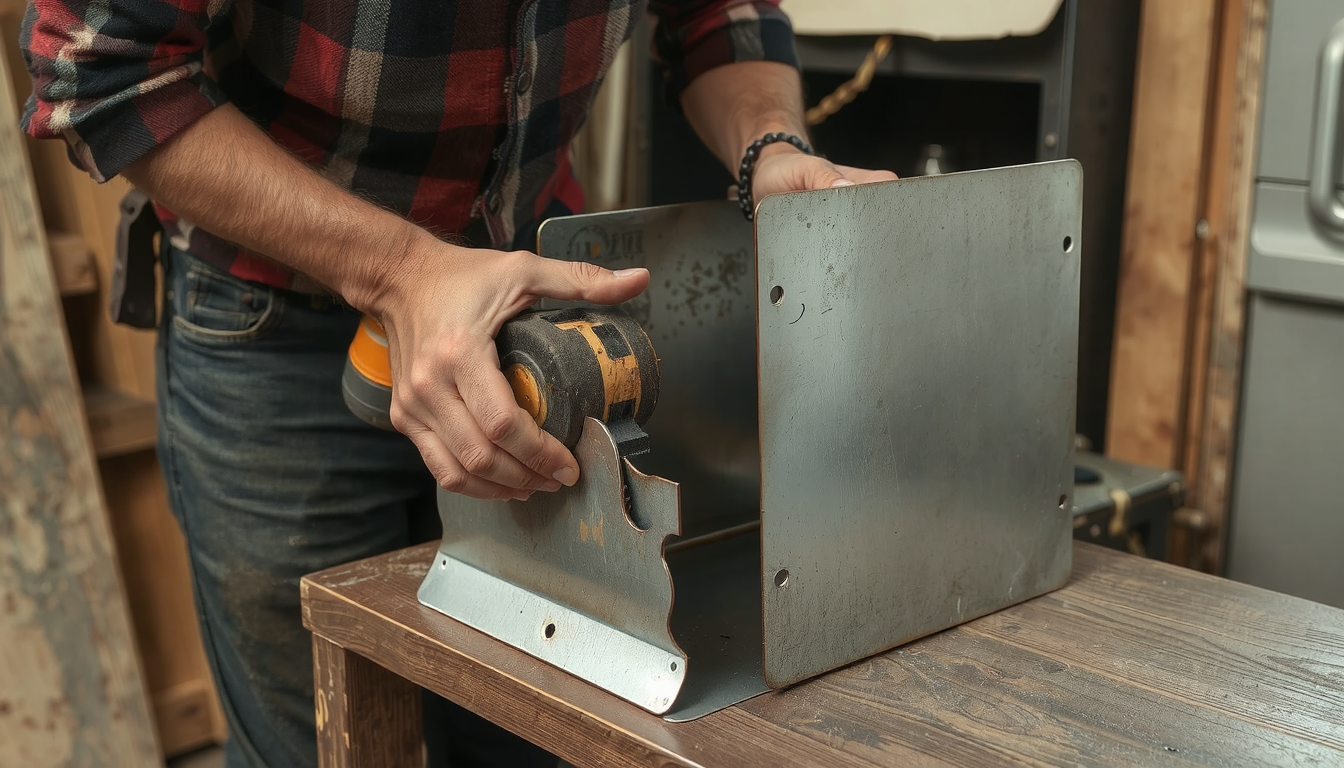
The most important point that you should take to heart amount before doing any cutting is planning your layout. A flat pattern is a secret key to a great box. This is your blueprint, drawn right onto the sheet metal. A good layout ensures that all parts fit well together. Planning is key when it comes to box construction with sheet metal as well.
Understanding the Flat Pattern: Hems, Sides, and Tabs
Your flat piece of metal will be cut and folded into a 3D shape. It needs to include these key parts:
- Base: This is the bottom of your box.
- Sides: These are the four walls that will be folded up from the base.
- Hems: These are the top edges of the sides. They are folded over on themselves. Hems do two things: they make the edge safe to touch by hiding the sharp cut, and they make the box much stronger.
- Tabs: These are small flaps on the edges of two of the sides. They are used to connect the corners of the box together.
Seeing a layout can make it much clearer. For a complete visual guide, you can look at a detailed visual step-by-step guide like this one from Instructables.
How to Calculate Your Cut Size (The Basics of Bend Allowance)
When you bend a piece of metal, the material on the outside of the bend stretches. This means you can’t just add up the lengths of the base and sides to get your total size. This concept is called bend allowance.
For a beginner working with thin metal (22-24 gauge), this effect is very small. You can get a good result by just drawing your lines as measured. Your first box will be close enough. As you get better, you can learn about formulas like K-factor to be more exact. But it is not needed for your first project.
Step-by-Step Layout Process
Follow these five steps to draw your pattern on the metal sheet.
- Use your rule and scribe to draw the base of the box in the center of your sheet metal.
- From each of the four edges of the base, measure and draw the four sides rectangles with the height of the box.
- Add a small amount of material to the outer edges of each side. This will become the hem. A 1/2-inch hem is good size.
- On two opposite sides, draw the corner tabs. These tabs should be on the sides, not the hems.
- Mark the corners that need to be cut away. They are the square sections between the side flaps. Double-check all your lines before moving on.
The Fabrication: Step by Step for Making Your Sheet Metal Box
As for the box you need now you can turn the sheet to make it. Work slowly and carefully and don’t forget to wear your glasses and gloves. This is particularly important when handling the freshly cut metal. This section describes the actual procedure of making the box from start to end.
Step 1: Cutting the Flat Pattern
Use your tin snips to cut out the flat pattern you drew.
- Use straight-cut snips for long, straight lines.
- Use left-cut (red) and right-cut (green) snips for curves and corners. They make it easier to turn.
- Cut away the corner sections that you marked earlier.
Try to make long, smooth cuts to avoid sharp, jagged edges. If you’re cutting out corners, use a pair of left- or right-cutting snips to navigate the turn more easily. After cutting, always deburr the edges with a file to remove dangerous sharp burrs. This is a critical safety step.
Step 2: Bending the Hems
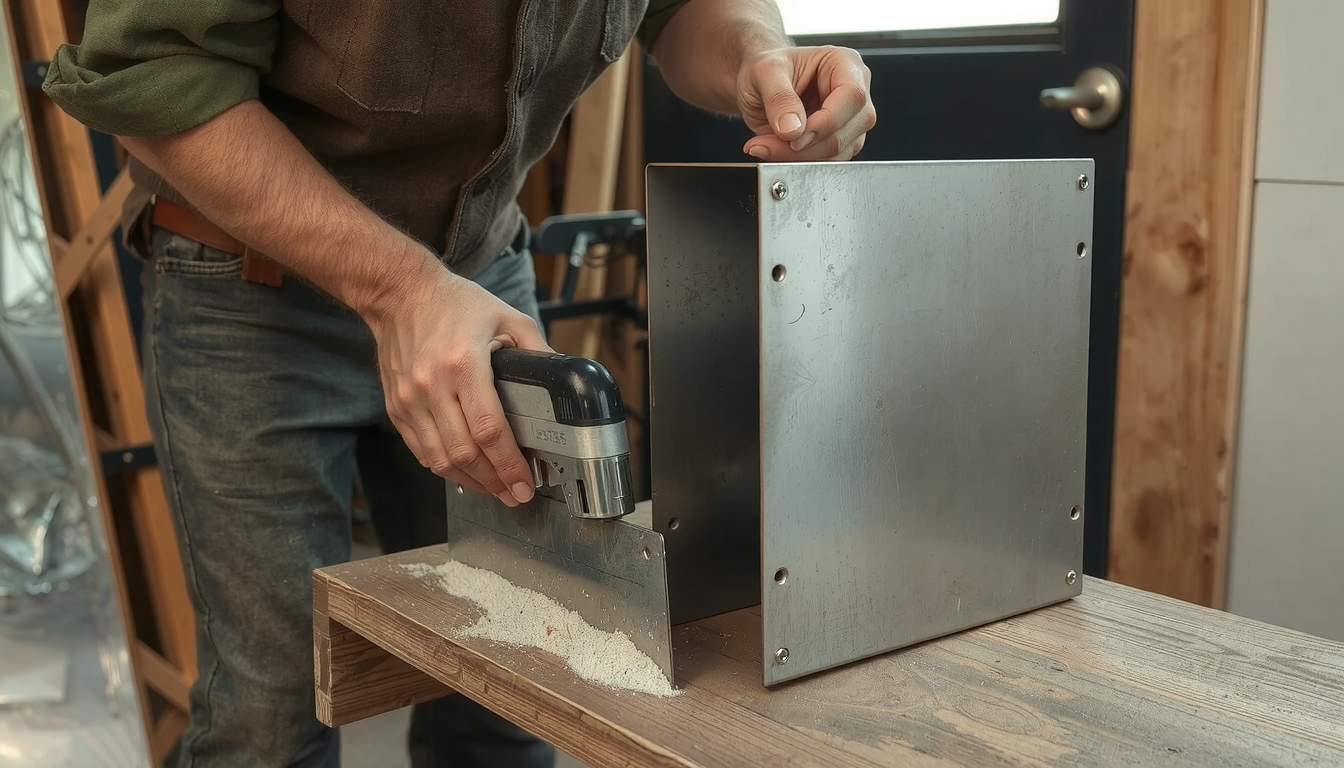
The hems are the first parts you should bend. This makes sure the sharp top edges are folded away safely before you do more work.
If you have a sheet metal brake, this is easy. Clamp the metal in the brake along the hem line and bend it over 180 degrees. Or bend it as flat as you can get it.
If you don’t have a brake, you can do it by hand. Clamp the sheet to a strong workbench. Place a block of wood along the bend line. Use a rubber mallet to gently hammer the hem over the edge of the workbench.
Step 3: Folding the Sides
Next, you will bend the four sides up to a 90-degree angle.
If using a box and pan brake, the order of bends matters. It is usually best to bend the two opposite sides that do not have the corner tabs first. Then, bend up the two sides that have the tabs.
Without a brake, use the same workbench-and-mallet method. Clamp the sheet with the bend line right at the edge of the bench. Use a block of wood to help create a sharp, straight bend as you hammer the side up to 90 degrees.
Step 4: Assembling the Corners
Your project now looks like a box. The last step in the configuration is to secure the corners.
Softly, insert the corner tabs on the next sides. The tabs lay on the inside surface against each other. Use spring clamps or locking pliers to hold the corners tightly together. This primes the bag for the final joining operation.
Joining It All Together: From Simple Folds to Permanent Welds
There are many choices for connecting the corners of your box. Choosing the method will depend on your resources and box’s strength requirement. Joining corners in various ways helps you improve your abilities.
Method 1: Riveting
- Pros: This is a sturdy and practical way that does not require heat. You only need a drill and a hand riveter.
- Cons: The rivet heads will be visible on outside. The joint is not waterproof.
Method 2: Spot Welding

- Pros: Very fast to create, a strong and clean looking joint. No visible fasteners.
- Cons: You need a specific spot welder, which can be costly.
Method 3: TIG/MIG Welding
- Pros: Result is the strongest joint possible. It can be completely seamless and waterproof if done right.
- Cons: Welding requires costly equipment and is difficult to do. It is particularly challenging with thin sheet metal. For those interested in industrial-grade assembly, techniques like TIG and MIG welding are standard in professional fabrication. This is detailed in this Custom Sheet Metal Boxes: Precision Crafting Guide.
Level Up: Final Touches and Complex Designs
A basic box is a good start. But by just adding a few extra steps you can achieve professional-looking results and add more functionality. A good finish will transform your plain sheet metal storage project into a truly custom piece.
Finishing for Durability and Style
- Deburring and Sanding: We previously mentioned this, but it is worth reiterating out every edge should be smooth and safe. Use files and sandpaper to achieve the perfect finish.
- Painting/Powder Coating: Use paint to protect metal steel from corrosion or make it colorful. First, clean the surface very good. Powder coating is a long-lasting finish that is high quality.
- Polishing: For metals such as aluminum or stainless steel, you can use polishing compounds. This creates a brilliant, mirror finish.
Adding Functionality
- Designing a Lid: You can create a simple, shoebox-style lid by making another, slightly larger box that is much shorter. You can also add hinges for a hinged lid.
- Adding Hardware: You can make your box more functional by installing handles, latches, and feet. You can add the unique, custom part such as knobs or feet by utilizing advanced CNC Lathe Services.
A well-designed safe offers a wide range of features. It can become a custom toolbox, an enclosure for electronic things, or a storage box with a decorative element. Be inspired by these projects for your next project.
Do-It-Yourself vs. Industry Grade: Knowing When to Seek Help
It is essential to understand when the project is suited for DIY and when it is better to bring in a professional. Figuring out if a DIY sheet metal box is an option for you indeed rests on the requirements of the project involved.
Go DIY if:
- You want to create just one, unique box.
- Your aim is to learn and enjoy the practical experience.
- High precision is not very much concerned.
Hire a Pro if:
- Many similar boxes are needed.
- The design involves complex bends or very high precision.
- You need special materials or a professional finish like powder coating.
In projects where accuracy, design complexity or quantity issues arise, it is always best to collaborate with a professional. Expert fabricación de chapa metálica operations possess sufficient machinery as well as experience which ensures perfect fabrication every time. If this course of action is attractive to you then check out a provider like Mekalite.
Frequently Asked Questions (FAQ)
1. What is the best sheet metal for a beginner to use?
Aluminum (around 16-20 gauge) is often the best choice for beginners. It’s lightweight and relatively soft and easy to bend. It is also naturally resistant to rust. Mild steel is another good option but is heavier and will require painting to prevent rust.
2. How can I make a sheet metal box without a brake?
You can make a sheet metal box without a brake by clamping the metal along the bend line to the edge of a strong workbench. Place a straight piece of wood or angle iron on top of the line. Use a rubber or wooden mallet to carefully hammer the metal down to a 90-degree angle.
3. What’s the easiest way to join the corners of a sheet metal box?
For a beginner, the easiest and safest method is using pop rivets. It only requires a drill to make the holes and a hand riveter to set the rivets. This creates a strong mechanical bond without needing any specialized welding equipment.
4. Why are the top edges of a sheet metal box folded over?
This folded edge is called a “hem.” It serves two crucial purposes. First, it removes the sharp, dangerous cut edge, making the box safe to handle. Second, it adds significant strength and rigidity to the top of the box. This prevents the walls from flexing.
5. How do I figure out the size of the flat piece of metal I need to start with?
To calculate the flat pattern, start with your desired base dimensions. Then, add the height of the walls twice to each dimension. For example, for a 10″x6″ base with 3″ high walls, your main rectangle will be (10 + 3 + 3) by (6 + 3 + 3), or 16″x12″. You must also add extra material for any hems you plan to include.
