



You can bend metal without a brake by making clean bends.

Of course, you can realize clean, straight bends in aluminum sheet metal independently. You don’t even need a costly press brake. A great number of DIYers look for the method of how to bend aluminum sheet metal without a brake. The solution is simpler than you may think.
Believe it or not, you can bend aluminum with just the right techniques and some tools that you usually find in your workshop. Build custom brackets, boxes, and art projects and more! With this guide, you are all set.
Main tasks for important prep work and four different methods for bending aluminum will be presented in this article. You will also discover some tips for troubleshooting and know when to seek professional assistance. Our Mekalite team is daily engaged in all things metal. This guide collects our experience and presents it in easy steps for your DIY projects.
Main Points
- Preparation is essential: Wear the correct safety gear. Use appropriate tools. Make sure the type of aluminum used isn’t too brittle to prevent cracking.
- Use the correct method: You can use a workbench edge to create simple bends. It might help to score the metal first to make sharper angles. A DIY wood brake is the best option for longer bends.
- Know the aluminum properties: Bend across the grain. The best choice is a soft alloy like 3003 or 5052.
- Consider springback: Since aluminum is elastic, it will spring back a little. To target the desired angle, you have to bend your part a little bit over.
- Seek professional help: When working with thick materials, complex shapes, or the need for absolute accuracy, the best way is to have it done by professionals.
Before Bending: Essential Prep For Best Performance
Good preparation is a good way to start your learning journey on how to bend aluminum sheet metal without a brake. Taking a few minutes to prepare your space, tools, and materials will be very helpful and will save you much trouble. You will not face wasted aluminum and injury risks.
Safety Comes First: Basic Precautions You Can’t Ignore
Even though aluminum is a soft metal to work with, it still has its safety risks. A freshly cut sheet can have very sharp edges, which can lead to accidents.
- Heavy-duty gloves: Your hands will be safe from any sharp edges and minor slips.
- Safety googles: Your eyes are shielded by the glasses from small pieces of metal that could fly off during cutting or bending operations.
- Secure work area: It is always a must to check whether the workpiece is firmly clamped. A loose piece of metal can move and either ruin your work or cause injury.
Bending Toolkit for Your DIY Project
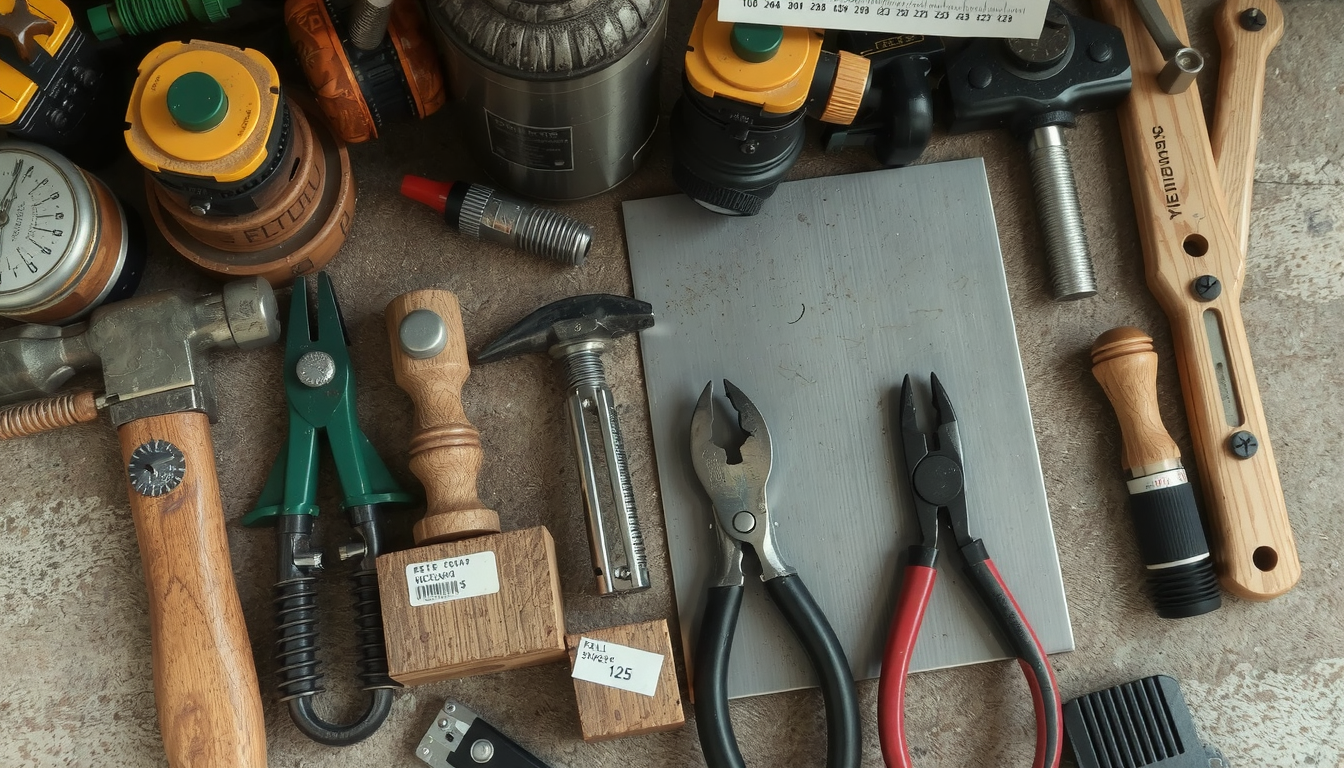
You don’t need a fancy shop to start out. Most of the tools mentioned here are probably in your garage already. They can also be found at any hardware store.
- A solid workbench or a pair of sawhorses
- Powerful C-clamps or Vise-Grips
- A rubber or dead-blow mallet
- A standard hammer and a small block of wood (to protect the aluminum surface)
- Two straight, stretched pieces of solid material such as hardwood blocks or angle iron
- A measuring tape and a permanent marker
- A reliable straightedge
Getting to Know Aluminum: Alloy, Temper, and Grain
Not all aluminum is the same. The alloy and temper of your sheet will determine how easy it is to bend. If you are trying the wrong type, it will lead to improper cracking and project failure.
Like wood, aluminum has a grain direction. This grain forms as the metal is rolled into sheets during manufacture. You can often line it up with very faint parallel lines on the surface. For the strongest and cleanest bend, you should always bend across the grain and not with it.
- Good for Bending: Look for softer alloys like 3003 or 5052. These are ductile, meaning they can be bent and formed without breaking. They are perfect for most DIY projects.
- Tough to Bend: Alloys such as 6061-T6 are way stronger and brittle. They are excellent for structural purposes, but probably crack if bent sharply. It requires specific equipment and methods like annealing (heat the metal to soften it).
4 Tested Techniques for Bending Aluminum Without a Brake
Below are four methods proven to be reliable for bending aluminum sheet metal. Each of the methods has its unique advantages and the best choice will depend on the available tools and the type of bend you wish to create.
Method 1: Workbench Edge & Mallet
This is the simplest way to give a bend in aluminum sheet metal. It works best for thin sheets (under 1/16″ or 1.6mm). The process is excellent for creating slightly rounded, simple bends.
- Use your measuring tape and marker to draw a clear, straight bend line on the aluminum sheet.
- Place the sheet on your workbench. Align the marked line perfectly with the edge of the bench.
- Lay a piece of hardwood or angle iron directly on top of your bend line. Use locks like C-clamps to clamp this guide and the aluminum sheet tightly to the workbench. The sturdier your setup, the cleaner your bend will be.
- You need your rubber mallet (or a hammer and wood block). Start to lightly tap along the overhanging edge of the aluminum. Don’t try to bend it all at once.
- Work your way forth and back all along the length of the bend line. Apply even pressure. You will soon see the aluminum start to fold.
- Repeat the process until you reach the required angle.
Method 2: Vise and Hand Pressure
For smaller aluminum parts, a bench vise provides significant clamping power. It acts as a mini-brake. This technique is excellent for creating small brackets or tabs.

- Start by marking your bend line on the small aluminum piece.
- To protect the surface of your aluminum from the vise jaws, you can use vise jaw liners. You can also use two small, flat pieces of wood.
- Clamp the piece in the vise with the bend line just above the top of the jaws.
- With your steady pressure push against the part of the sheet that is sticking out. For thicker pieces, you can take a wood block and spread the force. Use a mallet to gently help the bend.
- Check the angle you have and adjust as needed. This method gives you excellent control to form small components.
Method 3: Score-and-bend for sharper angles
The score-and-bend method, if your immediate project requires a clean, 90-degree corner. This is perfect for small boxes or chassis. Making a weak point is telling the metal exactly where to fold. This method is a practical way to bend sheet metal with common tools and get a professional look.
- Mark your bend line with care.
- Set a bold straightedge along this line. You require a sharp utility knife, press really hard and cut a shallow line. You will probably have to do it a few times.
- The target is a thin cut in the line that is no more than 1/4 of the thickness. A deeper cut will damage the corner too much.
- Set the sheet on the edge of your workbench as in Method 1. Put the scored line on the top and align with the edge.
- Now, when pressure is applied, the aluminum will be folded along the scored line. You might be able to finish this bend by hand. Use a wood block for even stress.
Method 4: Create a Simple DIY Wood Brake
For longer bends, particularly if you need to make several identical ones, it is more effective to build a simple brake out of wood and hinges. This will give you a better leverage and better level of consistency. You can find and build the Simple Sheet Metal Brake: No Welding easily with this plan.
- Two straight and sturdy pieces of wood like 2x4s are a good start. Cut them so that they are slightly longer than your widest bend.
- Put the two boards side by side. Attach them with two or three strong hinges. This will create a simple folding mechanism.
- Securely clamp one of the 2x4s to your workbench. This will be the fixed base of your brake.
- Slide the aluminum sheet between the two boards. Set your marked bend line with the center of the hinge pins.
- Clamp the aluminum sheet to the fixed board.
- Just lift the free board. The hinges act as a pivot, while the board provides the leverage that creates the clean, straight bend across the aluminum sheet.
Choosing the Right Method: A Comparison
Unsure of which technique would work best for your project? This table showcases which of the different methods of bending aluminum sheet metal at home are best to use.
| Method | Bend Sharpness | Best For… | Skill Level | Key Advantage |
|---|---|---|---|---|
| Workbench & Mallet | Rounded | Gentle curves, thin aluminum | Beginner | Minimal tools required |
| Vise & Hand Pressure | Sharp to Rounded | Small parts, brackets | Beginner | Excellent control for small pieces |
| Score-and-Bend | Very Sharp | Crisp 90° angles, boxes | Intermediate | High precision and sharp corners |
| DIY Wood Brake | Sharp & Consistent | Long, straight bends, repeat parts | Beginner | Excellent leverage & consistency |
Troubleshooting & Pro Tips
Even when you do everything right, you can still face some issues. Here are some professional hints for fixing common problems encountered in bending aluminum sheet metal without a brake.
Why Did My Aluminum Crack?
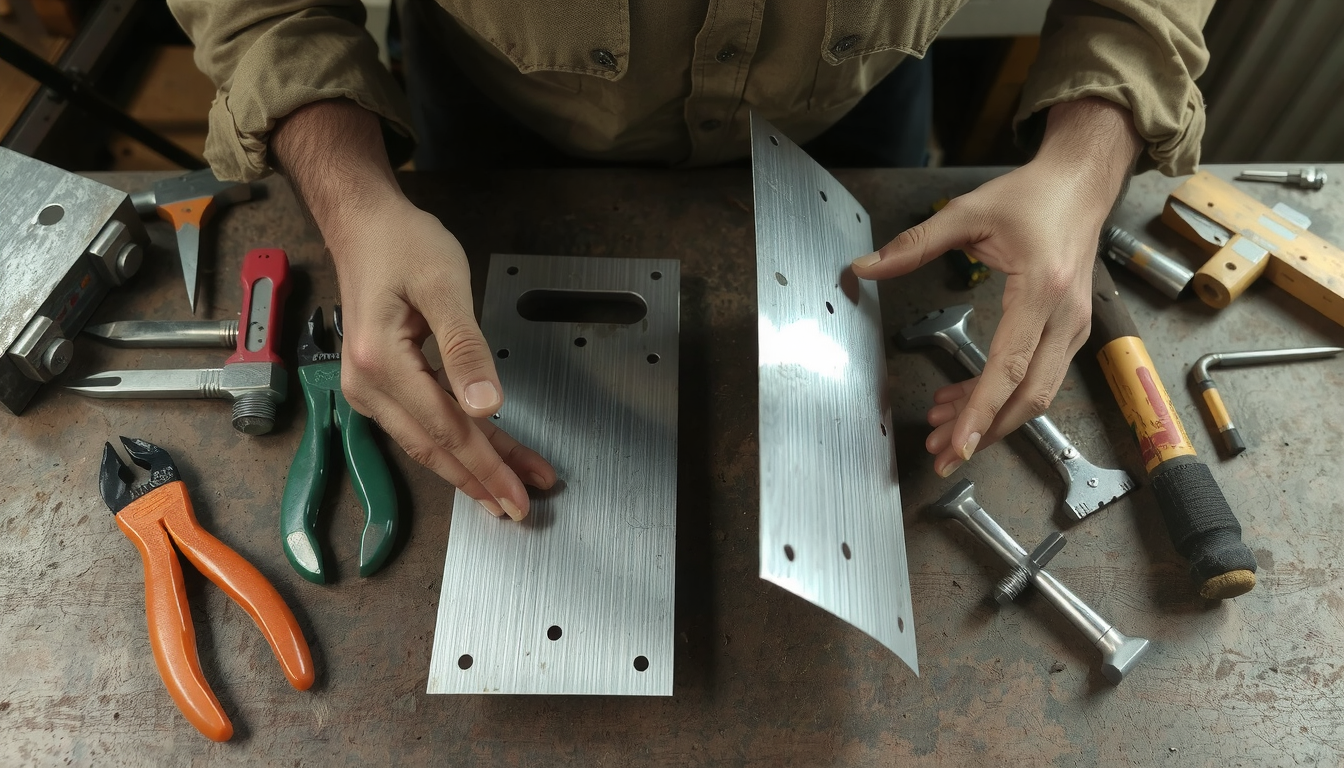
Cracking is the most frequent problem. Usually, there are three reasons:
1. Wrong Alloy: You attempted to bend a brittle alloy like 6061-T6. Stick with 5052 or 3003 for DIY projects instead.
2. Bending Parallel with the Grain: You did bend the sheet parallel to the metal’s grain direction. It should always be done across the grain.
3. Too Tight of a Bend Radius: Every sheet has a minimum bend radius, given the thickness. If you try to create a bend that is too tight the material outside of the bend stretches too much and cracks. The score-and-bend method can help in this situation. But for thick material, a rounded edge is the most practical.
What is “Springback”?
Aluminum is a very resilient material. After bending a 90-degree angle and releasing the pressure, it will “spring back” a few degrees. It may go to 88 degrees or even 87 degrees. This is totally normal.
In order to counterbalance the springback, you have to slightly over-bend. For a 90-degree bend, you might need to try bending it to 92 or 93 degrees. It takes a little practice to figure out how much your specific material will spring back.
Integration of Bent Parts with Other Components
Quite often the bent aluminum piece is just one of the components within a larger assembly, which needs to fit in with other brackets, fasteners or mounts exactly. If your project requires custom threaded standoffs or unique mounting hardware to match your newly bent part, it will be very difficult to achieve that precision in your workshop. In such case, professional CNC lathe services can produce exact components as needed. They will ensure the complete fit and the professional finish.
When DIY Is Not Enough: The Professional Advantage
DIY methods for bending aluminum sheet metal without a brake can be effective in many cases but they are not always enough. If you are too busy or would like the job to be done perfectly, you should know how to identify situations that warrant the use of a professional fabrication shop.
You might want to consider professional help if the following situations arise:
- Material Thickness: Working with aluminum thicker than 1/8″ (~3mm) is almost impossible without using hydraulic machinery.
- Complex or Compound Bends: If your component needs simultaneous bends on different axes or tight angles, a press brake is necessary.
- Precision is Critical: Only CNC machines can guarantee that level of perfection when the tolerances are close and each angle must be exact.
- Cosmetic Finish is a Priority: The methods employed in DIY projects can at times leave small imperfections or marks.
For projects that demand perfect accuracy, complex shapes, or a pristine finish, professional sheet metal fabrication is the ideal solution. These services use advanced technologies like CNC press brakes and laser cutters. They deliver industrial-grade results that are impossible to achieve in a home workshop.
Frequently Asked Questions (FAQ)
What is the thickest aluminum sheet I can bend without a brake?
For most DIY methods, it’s best to stick to 1/16″ (1.6mm) or thinner aluminum. With a very robust DIY wood brake and good leverage, you might manage up to 1/8″ (3mm) in a soft alloy like 3003. But it will require significant force and is more likely to be inconsistent.
Do I need to heat the aluminum before bending it?
Heating, also known as annealing, can make aluminum softer and much easier to bend. This is especially helpful for thicker pieces or slightly more brittle alloys. You can use a propane torch to heat the bend line evenly. A common trick is to coat the line with a permanent marker. When the heat causes the marker ink to turn brown or disappear, the metal is at the right temperature. Let it cool down naturally in the air before you attempt the bend. Be careful not to overheat the aluminum, as this can make it too soft and weak.
How do I find the grain direction in an aluminum sheet?
Look very closely at the surface of the sheet, preferably in good light. You should be able to see very faint, parallel lines or a “brushed” texture all running in one direction. This is the grain from the rolling process. Plan your bend so that the bend line runs perpendicular (at a 90-degree angle) to these grain lines.
Can I use these methods for steel sheet metal?
Yes, but with major limitations. Steel is much stronger and less flexible than aluminum. The methods described here will generally only work for very thin gauge steel (e.g., 22 gauge or thinner). Attempting to bend thicker steel sheets with these techniques will be very difficult and likely unsuccessful without much more force.
What’s the best tool for cutting aluminum sheet before bending?
For thin sheets (under 1.2mm), a good pair of aviation snips (also called tin snips) works very well for straight or curved cuts. For thicker sheets, a circular saw equipped with a carbide-toothed blade designed for non-ferrous metals will give you a fast, clean, and straight cut. A jigsaw with a metal-cutting blade is also a great option, especially for making intricate cuts.
